
The Hickory Algorithm
Thursdays, are for the Midwife Maven. What the research says about women, longevity, and the choices that matter the most.


You’re Not Just Managing Symptoms.
You’re Deciding How You Age.
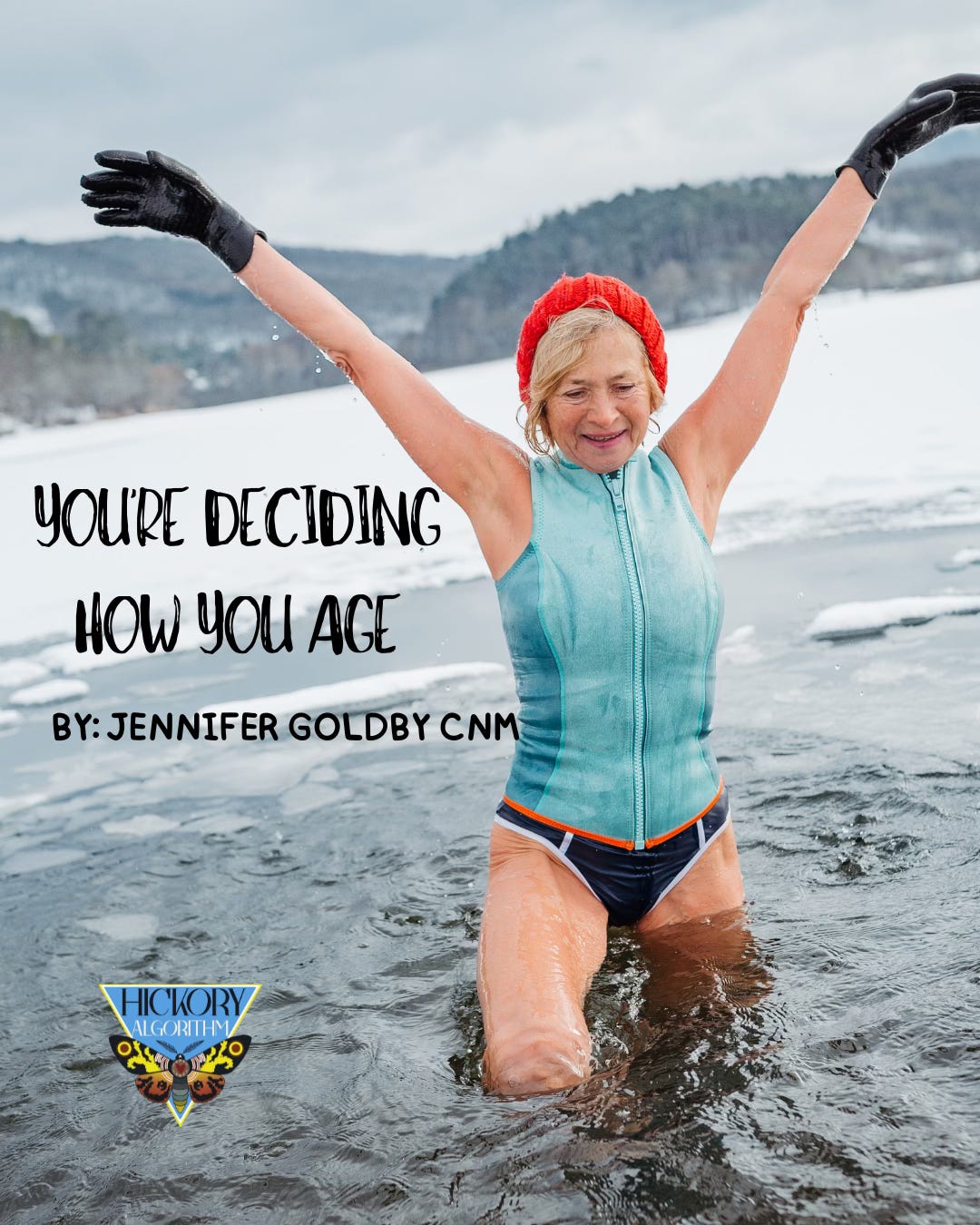
I want to talk to you about something that doesn’t come up enough in a standard gynecology visit.
By the time a woman walks into my office in her 40s or early 50s, the conversation is usually about what’s bothering her: the sleep that’s gotten worse, the periods that have changed, the way her body doesn’t feel quite like hers anymore. And those things matter. We’re going to address them.
But there’s a bigger conversation I think you deserve to be part of. Because what’s happening in your body right now, hormonally and metabolically, is directly shaping the second half of your life. Not in a vague, abstract way. In a measurable, research-backed way.
The decisions you make during perimenopause and the years just after, around movement, muscle, stress, sleep, and sometimes hormones, are among the most important health decisions you will ever make. Most women don’t know this. I want to change that.
So let’s talk about what actually predicts a long, healthy life, and why your forties and fifties are exactly the right time to be paying attention to it.
Your Fitness Level Matters More Than Almost Anything Else
There’s a number called VO2 max. You’ve probably heard of it if you follow any fitness content, but I want to give you the clinical version of why it matters.
VO2 max measures how efficiently your body uses oxygen during exercise. It reflects how well your heart, lungs, blood vessels, and muscles are all working together. And study after study has found it to be one of the strongest predictors of how long you live.
A study published in JAMA Network Open followed over 122,000 adults and found that people in the lowest fitness category had nearly four times the mortality rate of those in the highest fitness category. That gap was bigger than the mortality difference between smokers and non-smokers. Bigger than having a heart disease diagnosis.
That finding has been replicated across multiple large studies. Every small improvement in cardiovascular fitness translates to a measurable reduction in death risk. One long-term study found that each unit increase in VO2 max added 45 days to life expectancy, on average.
The biggest benefit doesn’t come from becoming an athlete. It comes from moving out of the lowest fitness category. That is a completely achievable goal for most women.
Here’s where menopause enters the picture. Estrogen supports cardiac function, mitochondrial efficiency in muscle, and the maintenance of muscle mass itself. When estrogen declines, these systems are affected. VO2 max tends to fall more sharply during the menopausal transition if nothing changes. The good news is that women respond well to aerobic training at every age, including after menopause. The HERITAGE Family Study, which specifically studied postmenopausal women, confirmed this clearly.
What this looks like practically
Zone 2 cardio is your foundation. That means sustained moderate effort, the kind where you can hold a conversation but you know you’re working. Walking briskly, cycling, swimming, hiking. Aim for 150 to 180 minutes per week. If you want to push your VO2 max higher, adding one or two harder interval sessions per week helps. You don’t need a gym membership or a trainer to start. You need consistency.
Muscle Is Not About How You Look
Muscle is one of the most metabolically important tissues in your body. It regulates how well you handle blood sugar, supports your bones, protects your joints, and is one of the best predictors of functional independence as you get older.
There’s a condition called sarcopenia, which is the gradual loss of muscle mass and strength that comes with aging. It’s common, it’s serious, and it’s almost never discussed in a gynecology appointment. Researchers project that by 2045, over 70% of adults over 65 globally will be affected.
Grip strength, which is measured by a simple handheld device, has been shown to independently predict cardiovascular mortality, fall risk, cognitive decline, and even how well someone recovers from surgery. It’s a window into systemic health that costs almost nothing to assess.
Losing muscle strength is not an inevitable part of aging. It’s something we can actively work against, and the perimenopausal years are when that work matters most.
Estradiol, the main estrogen your body produces before menopause, has receptors directly in skeletal muscle tissue. It supports the satellite cells that repair and rebuild muscle, limits inflammation in muscle, and helps regulate how muscle handles fuel. When estradiol falls, muscle protein breakdown accelerates and inflammatory markers rise. One longitudinal study found a 15% decrease in muscle mass and a 20% drop in grip strength over just five years post-menopause.
A 2023 Menopause Society study found that women with longer reproductive lifespans, meaning more years of natural estrogen exposure, had significantly lower rates of low grip strength. The biology is real.
What this looks like practically
Resistance training is the intervention with the strongest evidence. Lifting weights, using resistance bands, or doing bodyweight work that genuinely challenges your muscles, at least two to three days a week. Protein intake matters too. Most women eat far less than they need, particularly during this transition. A target of 1.2 to 1.6 grams of protein per kilogram of body weight daily, spread across meals, is what the research supports.
Bone Loss Is a Longevity Issue, Not Just a Fracture Issue
You probably know that menopause accelerates bone loss. What often gets skipped over is why this matters beyond falls and fractures.
A hip fracture in a woman over 65 carries a one-year mortality rate of 20 to 30%. That’s not a small number. A fracture is not just a painful inconvenience. For many women, it marks the beginning of a cascade of health decline that significantly shortens their life.
Bone loss begins three to five years before the final menstrual period and continues at an accelerated rate for roughly seven to ten years after. This is when intervention makes the most difference, through movement, nutrition, and when appropriate, hormonal or pharmacologic treatment.
What this looks like practically
Weight-bearing exercise and resistance training both stimulate bone remodeling. Calcium from food first (dairy, leafy greens, fortified foods), supplemented as needed to reach 1,000 to 1,200 mg daily. Vitamin D supports calcium absorption, and most women in the US are low; 2,000 IU daily is a reasonable starting point while you get your level checked. A DEXA scan at menopause, or earlier if you have risk factors, gives you an actual baseline to work from.
Your Standard Lab Work May Be Missing the Story
Heart disease is the leading cause of death in women. Not breast cancer. Not ovarian cancer. Heart disease. And a lot of the metabolic changes that set the stage for it accelerate right around perimenopause, often quietly, while standard labs look normal.
Here’s what happens. Estrogen does a lot to protect vascular and metabolic health. It supports insulin sensitivity, keeps visceral fat in check, and helps maintain a favorable cholesterol pattern. When estrogen drops, visceral fat tends to increase even without weight gain, insulin resistance worsens, and the LDL particles that do show up on your labs can become smaller and denser, which is actually more dangerous even if the total number hasn’t moved much.
Standard lipid panels catch some of this, but not all of it.
Labs worth asking about
Fasting insulin and a calculation called HOMA-IR can reveal insulin resistance years before blood sugar rises into the diabetic range. A triglyceride-to-HDL ratio above 2.0 is a signal worth paying attention to. HbA1c gives a three-month average of blood sugar that can catch early abnormalities in your blood sugar levels. High-sensitivity CRP measures systemic inflammation, which accelerates both cardiovascular and cognitive aging.
None of these are exotic. They’re just not in the standard panel your primary care doctor orders annually. They tell a more complete story, and this is exactly the kind of story worth telling at midlife.
Your Brain Is Going Through the Transition Too
Women develop Alzheimer’s disease at twice the rate of men. That gap is not fully explained by the fact that women live longer. There are sex-specific biological factors at play, and one of them appears to be the hormonal shift of menopause itself.
Estrogen receptors exist in the brain, including in areas responsible for memory and executive function. When estrogen declines, these regions are affected. Many women notice it during perimenopause as word-finding problems, brain fog, or short-term memory glitches. This is real. It’s documented. And it’s worth taking seriously.
The timing question
There’s been a lot of confusion in the media about hormone therapy and dementia risk, mostly stemming from a large study called WHIMS, which found increased dementia risk with combination hormone therapy. Here’s what often gets left out: the women in that study were an average of 15 years past menopause when they started treatment.
More recent research tells a different story for women who start hormone therapy close to the menopausal transition. The KEEPS trial, which enrolled women within three years of their last period, found no cognitive harm and some signal of benefit for memory. The WHIMSY trial, which looked at women who had used estrogen in their early 50s, found no increased cognitive risk over ten years of follow-up. A 2024 meta-analysis concluded that estrogen therapy started in midlife was associated with improved verbal memory.
The research suggests there may be a window, early in the transition, when estrogen supports brain health in ways that aren’t available decades later. This is one more reason the conversation about hormones shouldn’t wait.
What you can do regardless
Sleep quality is one of the most powerful and underused levers for cognitive protection. Chronic poor sleep accelerates cognitive decline and is strongly linked to Alzheimer’s risk. Addressing menopause-related sleep disruption is not just about comfort.
Blood pressure management, blood sugar control, regular aerobic exercise, and social connection all have solid evidence for protecting cognitive function as we age. These aren’t abstract recommendations. They’re the same things that protect your heart, your muscles, and your metabolic health. The whole system is connected.
Stress Isn’t Just in Your Head. It’s in Your Biology.
There’s a concept in medicine called allostatic load. It refers to the cumulative biological cost of chronic stress on the body. When the nervous system is chronically activated, inflammation rises, blood vessels age faster, hormone regulation is disrupted, and the immune system shifts in ways that increase disease risk over time.
The research on Adverse Childhood Experiences, or ACEs, makes this concrete. The original ACE Study, published in 1998 by Felitti and colleagues and replicated many times since, found that higher numbers of adverse childhood experiences were significantly associated with increased rates of heart disease, autoimmune conditions, cancer, depression, and early mortality in adulthood. These weren’t small effects.
At the cellular level, chronic stress and early adversity are linked to shorter telomeres, the protective caps on our DNA that shorten as we age. A 2024 meta-analysis found that higher cardiorespiratory fitness was associated with longer telomere length, suggesting that exercise may be one of the ways we can partially counteract the biological aging effects of accumulated stress.
I bring this up not to be heavy, but because it’s clinically honest. The body keeps score in ways that show up on labs and in disease patterns. If you’ve carried a lot, your physiology reflects that. It’s not your fault. And there are things that help.
What helps
Regular aerobic movement reduces inflammatory markers and improves how the nervous system regulates itself. Trauma-focused therapy addresses the root patterns of chronic dysregulation in ways that lifestyle changes alone cannot. Sleep, as always, is foundational. So is having a care provider who isn’t going to gloss over your history to get to the checklist.
Trauma-informed care shouldn’t be a specialty add-on. It’s how I practice. Because it matters to your biology, not just your wellbeing.

Sources
All clinical information in this post is drawn from peer-reviewed research.
Mandsager K, et al. Association of Cardiorespiratory Fitness With Long-term Mortality Among Adults Undergoing Exercise Treadmill Testing. JAMA Network Open. 2018;1(6):e183605.
Erikssen G, et al. Midlife Cardiorespiratory Fitness and the Long-Term Risk of Mortality: 46 Years of Follow-Up. Journal of the American College of Cardiology. 2018;72(9):987-995.
Systematic Review and Meta-analysis Highlights a Link Between Aerobic Fitness and Telomere Maintenance. Journal of Gerontology. 2024;80(6).
HERITAGE Family Study. Effects of exercise training on cardiorespiratory fitness in postmenopausal women. Multiple publications, 1995-2004.
Frontiers in Endocrinology. Research Progress on the Correlation Between Estrogen and Estrogen Receptor on Postmenopausal Sarcopenia. 2024.
MDPI. Hormonal Influences on Skeletal Muscle Function in Women Across Life Stages: A Systematic Review. 2024;3(3).
The Menopause Society. Association Between Reproductive Period and Handgrip Strength in Postmenopausal Women. Menopause. 2023.
The Menopause Society. Low Creatinine-to-Cystatin C Ratio as Predictive Biomarker for Sarcopenia in Midlife Women. Menopause. March 2025.
Gleason CE, et al. Long-term Cognitive Effects of Menopausal Hormone Therapy: Findings from the KEEPS Continuation Study. PLoS Medicine. 2024;21(11):e1004435.
Nerattini M, et al. Systematic Review and Meta-Analysis of the Effects of Menopause Hormone Therapy on Cognition. Frontiers in Endocrinology. 2024;15.
Frontiers in Molecular Biosciences. Estrogen, Menopause, and Alzheimer’s Disease. 2025.
Felitti VJ, et al. Relationship of Childhood Abuse and Household Dysfunction to Many of the Leading Causes of Death in Adults: The ACE Study. American Journal of Preventive Medicine. 1998;14(4):245-258.
Journal of the American Heart Association. ACEs and Central Arterial Stiffness. 2022.
Last week’s post:
Creatine for Perimenopause
 | A guest post by
|